
I have recently returned from my second program during my gap year, ten weeks in the Swiss Alps where I learned to be a ski instructor. Coming home, excited to see my little brothers, I’ve spent a lot of time trying to learn who they’ve become since I left. They’re both taller, smarter, more coordinated, and more articulate. But the most significant change wasn’t physical—it was a change in focus.
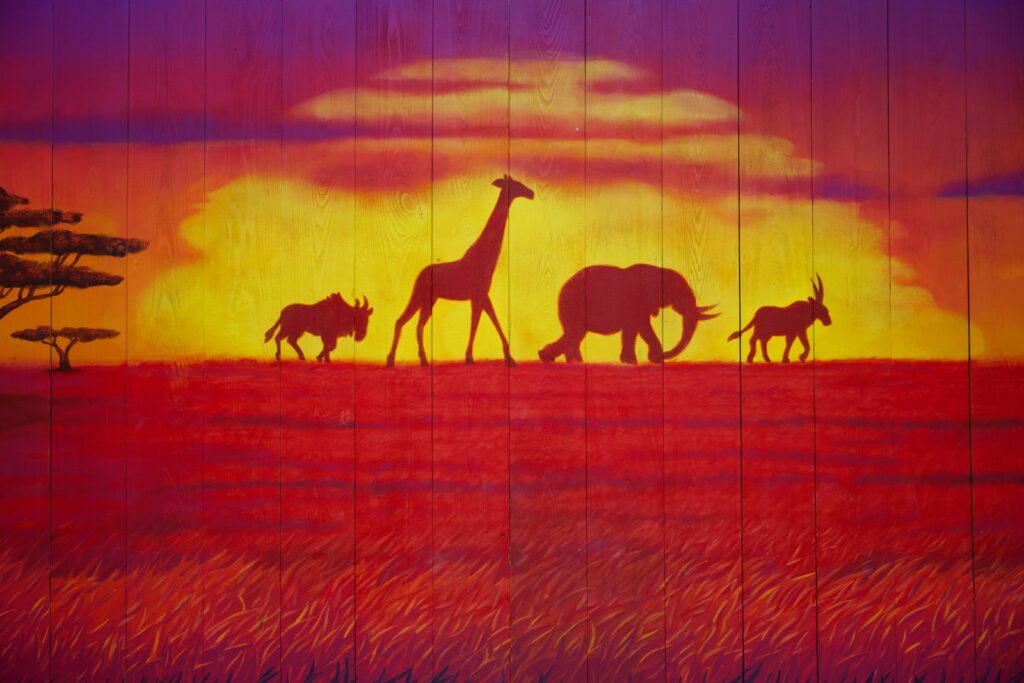
My little brother Henry wakes up thinking about Africa.
He goes to bed thinking about Africa.
It’s not just a topic he likes—it’s the way he explores the world. He has memorized the 54 flags, countries, populations, languages, leaders, geography, wildlife, and even some folklore—not because anyone told him to, but because he can’t stop thinking about it.
But what fascinates me most is that Africa isn’t just an interest to him—it’s a framework. He doesn’t turn on the TV—he prints fact sheets and creates informational cards from workbooks and websites. He doesn’t just think about Africa—he structures his world around it, using it as a way to interact with others, share facts, ask questions, and make art. He doesn’t let engagement happen by accident—he makes it inevitable. Watching him, I realized something: Henry doesn’t just learn about Africa. He builds a world around it.
That made me ask myself: What is my Africa?
ADHD, Deep Focus, and the Challenge of Engagement
Henry and I both have ADHD, and if there’s one thing I understand about it, it’s this: If we aren’t curious about something, it feels impossible to focus. But when we are, we can hyperfocus. Our attention tends to be all-or-nothing—either completely absorbed or entirely absent. We are our best selves, interacting in the world in complex and interesting ways. Acting on our interests counteracts the struggles that ADHD causes. We can dive deep, almost obsessively, completely immersed in an idea or subject for hours, days, or even weeks.
And that’s what fascinates me about Henry’s Africa. His engagement isn’t forced—it’s effortless. His passion overrides any distraction, impulse, or desire to do something else. He is completely consumed by his intrigue. For me, it is beautiful to watch as he seems to change, a perpetually churning mind quieting down.
I have experienced this before, too. When I was younger, I entertained myself with fantastical stories from mythology, creating my own stories, and sharing what I learned. Later, it was engineering and physics—how humans built impossible things and how mathematicians conquered ideas about time, energy, and the universe.
I love exploring the concept of innovation. Especially in space, the new frontier. Satellites, rovers, rockets, asteroid mining, and other wonderful technologies that allow us to push boundaries lit a fire in my imagination. More recently, I have found solace in classic Russian literature—not just for the books themselves, but because they felt like a cultural code, something others had strong opinions about.
Each time I discovered an interesting thread, I went all in—until I didn’t. Until the next impulse pulled me somewhere else. And that’s the challenge: I can go deep, but without structure, my engagement can be fleeting.
This pattern of intense but temporary focus made me wonder what factors or structures influence sustained engagement. Looking back at my gap year experiences to date, I realize that the environment plays a crucial role.
The Role of Environment: Himalayas vs. Verbier
I’ve spent this gap year in wildly different environments, and I’ve seen firsthand how much environment shapes my engagement.
The Himalayas: Total Presence, No Distractions
Earlier this year, when I spent 40 days trekking through the Himalayas with a small expedition team, I experienced a different quality of focus than I’d ever known before. It wasn’t a challenge—it was inevitable. There were no distractions. No phone. No reason to stay awake or stay out. No social pull in a hundred different directions. The only thing to focus on was the experience itself, the people I was with, and the physical challenge ahead.
I wasn’t taking my ADHD medication, but I was more focused than I had ever been. I read for hours daily, journaled, had deep conversations, ate well, and slept well. I felt like my best self—not scattered, not stressed, not pulled in a million directions. I wasn’t fighting for focus. Focus was just there.
Verbier: An Environment of Endless Impulse
Verbier was the opposite. Every day, from the moment I woke up to the moment I went to bed, there was something pulling my attention. Skiing, socializing, going out—every impulse had an outlet. And I said yes to everything. Because why wouldn’t I? At first, it was exciting. But when I got home, I felt flat.
Something was off.
Suddenly, even the smallest structured task—reading, setting a routine, going to bed at a reasonable hour—felt impossible. And I realized something: In the Himalayas, my environment made focus effortless. In Verbier, my environment made impulse control feel impossible. And when I came home, I didn’t know how to reset.
Henry’s Africa vs. My Search for Deep Engagement
What sets Henry’s engagement apart isn’t just his interest in Africa but the intentional system he’s built around it. That’s why he fascinates me. He doesn’t struggle with focus because his world is designed for engagement. He doesn’t just learn about Africa—he structures his curiosity. He creates systems, fact files, workbooks, conversations, and creative projects. He spreads them to the world, whether people accept them or not. He doesn’t leave engagement up to chance—he makes it inevitable. And I need to do the same.
My Commitment: Building, Not Just Finding, My Africa
Because I know what fascinates me: Innovation. Not just new technology, but the stories of how ideas evolve over time. The hidden threads that stitch together breakthroughs. The way some ideas take root only when the world is ready for them. The way co-developments happen across continents and generations. This has always excited me. While we’ve worked on a lot of different approaches through Service Academy, I’m still working on the engagement framework that resonates most with me. Without a framework, interest alone isn’t enough.
Henry’s Africa isn’t just a topic—it’s a structured system of engagement. If I want to engage deeply, I can’t just wait for passion to hit me. I need to design an environment that makes depth and focus easy.
That means:
- Setting up my space for deep exploration—Not leaving my intellectual interests to impulse.
- Choosing how I engage—reading deeply, documenting thoughts, connecting ideas across fields.
- Recognizing that impulse control isn’t about willpower—it’s about structure.
Because passion alone isn’t enough.
The real challenge—the real commitment—is to make sure that when I find something worth exploring, I don’t just touch the surface. I build my world around it.
Final Thought: What’s Your Africa?
Henry’s Africa is his intellectual home base—the place he can always return to, the framework that lets him go deep.
I’m building mine by creating dedicated space and time for deep exploration, systematically documenting connections between innovations across fields, and finding communities that share this passion. I’ve started by setting aside two hours each morning specifically for reading and journaling about innovation, free from distractions.
What’s yours?
More importantly, how are you structuring your world to make sure you can truly engage with it?
– Thomas Growney
Co-founder, Service Academy
About Our Gap Year Journey
We’re Ryan and Thomas Growney, twin brothers and co-founders of Service Academy.
After graduating from St. George’s School in Rhode Island, we’ve embarked on a gap year to explore how different cultures approach problem understanding, community engagement, service, and social innovation.
Our journey will take us to various countries, including South Africa, where we’ll participate in the Tilting Futures program, and the Himalayas, where we’ll be joining the NOLS for a high-altitude mountaineering challenge. Throughout this year, we aim to challenge our assumptions, broaden our perspectives, and gather insights that will help us enhance our approach to social impact back home.
Ryan is particularly interested in scaling service initiatives to develop young leaders, while Thomas focuses on the personal connections and community belonging that service creates. By sharing our experiences, we hope to contribute to a broader dialogue about service, mentorship, community engagement, and cross-cultural learning.
We invite you to follow along on our journey, engage with our reflections, and share your own insights about service in diverse contexts.
Together, we can work towards creating more meaningful and impactful youth service ecosystems that benefit both young people and their communities.